

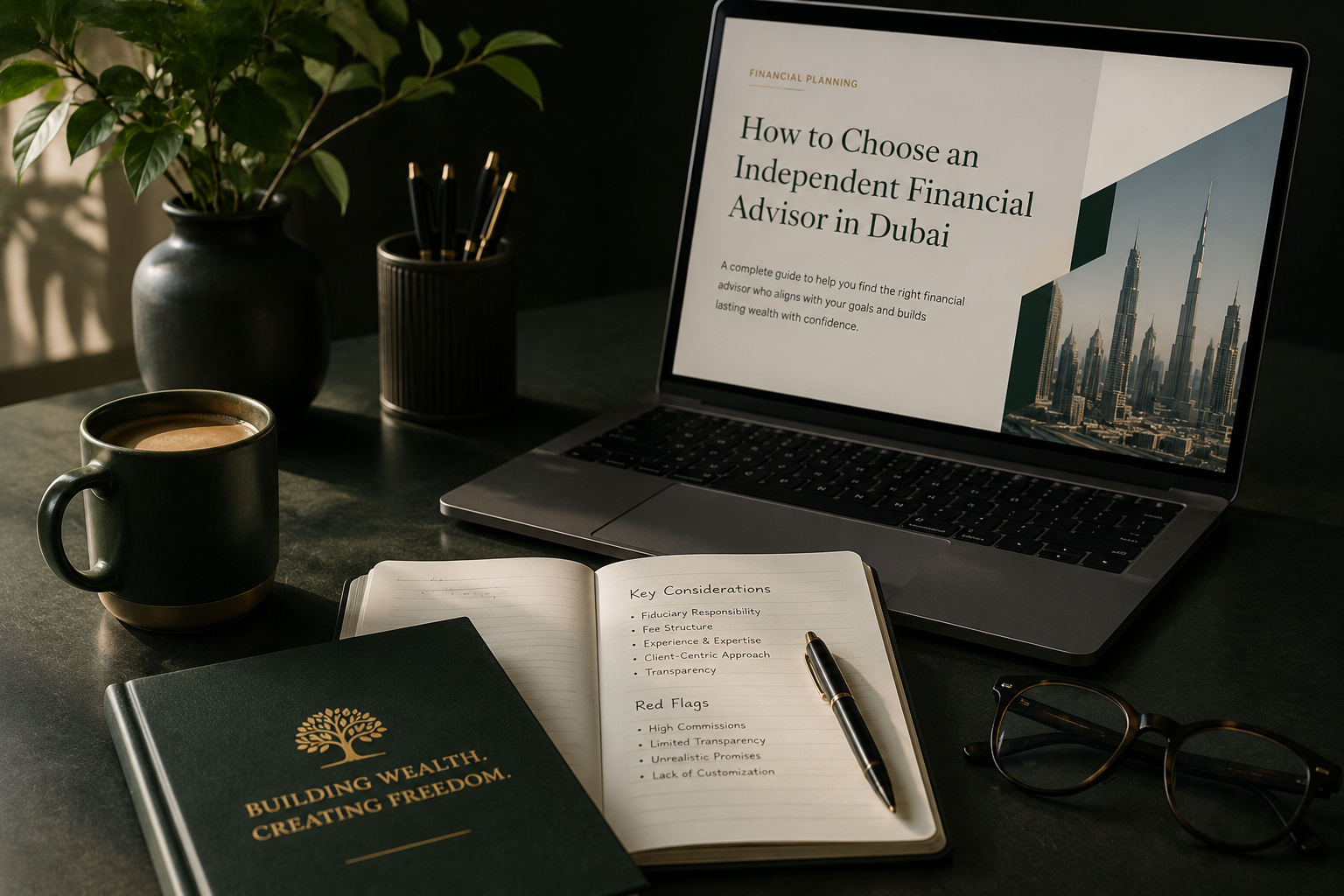
Dubai’s financial advisory market is large, well-resourced, and — for the uninitiated — deeply confusing. Thousands of professionals offer some form of financial guidance across the emirate, ranging from regulated investment managers to retail bank wealth advisors to independent consultants. Choosing the right one can be the difference between building lasting wealth and spending years inside expensive, poorly performing financial products you didn’t fully understand when you bought them.
This guide explains what to look for, what questions to ask, and what warning signs to avoid when selecting a financial advisor in Dubai.
What Is an Independent Financial Advisor?
An independent financial advisor (IFA) is a qualified financial professional who provides advice on financial matters without being tied to any single institution, bank, or product provider. Unlike bank advisors or tied agents — who represent specific products from their employer or a limited panel of providers — an independent advisor can recommend solutions from across the entire market, selecting what is genuinely best for each individual client.
Independence is not just a marketing label. It has practical implications: an independent advisor is remunerated for their advice (either through a fee you pay directly or a disclosed commission), not through undisclosed incentives from the products they recommend. In a market like Dubai, where regulatory oversight of advisory practices is still maturing, genuine independence is one of the most valuable qualities a financial advisor can demonstrate.
Why Dubai’s Advisory Market Requires Extra Diligence
Dubai attracts financial advisory firms from around the world, and the emirate’s affluent, internationally mobile population makes it a particularly active market. However, unlike the UK, Australia, or the EU — where regulatory reforms have significantly constrained commission-based advice — the UAE’s advisory sector still permits widespread commission-based remuneration for advisors recommending financial products such as investment-linked insurance bonds, savings plans, and offshore investment structures.
The consequence is that many individuals in Dubai have purchased financial products — often long-term savings plans with 10 or 25-year lock-in periods — that served the advisor’s income more than the client’s objectives. The products are not necessarily fraudulent, but their internal charges, inflexibility, and limited investment options frequently produce outcomes well below what a client with objective advice could have achieved.
This context makes the selection of a truly independent advisor not just desirable, but financially critical.
7 Criteria for Choosing Your Financial Advisor in Dubai
1. True Independence — No Undisclosed Product Affiliations
Ask directly: “Are you affiliated with any financial product providers? Do you receive any commissions or volume-based incentives from product companies?” A genuine independent advisor will answer these questions transparently. Any evasion or vague claims of “best advice” without specifics about remuneration should be treated as a red flag. True independence means the advisor is paid for their advice — whether through a flat fee, hourly rate, or percentage of assets under guidance — with any product-related income fully disclosed and credited against your costs wherever possible.
2. Breadth and Integration of Services
A quality financial advisor in Dubai should be able to address your financial life comprehensively — not just one element of it. Look for advisors who cover financial planning and investment advisory, insurance and protection, estate and succession planning, and — for business owners — company structuring and HR advisory. Integrated advisory means recommendations across areas are coordinated to work together, rather than addressing each in isolation.
3. Transparent, Disclosed Fee Structure
Before engaging any advisor, request a clear, written explanation of how they are remunerated. This should cover: what fee you pay directly (if any), what commissions or payments they receive from product providers (if any), how these are disclosed and managed, and what ongoing service costs look like after the initial engagement. Opacity on fees is a direct signal that the advisory model prioritises the advisor’s revenue over your interests. The best advisors welcome these conversations.
4. UAE and Expatriate-Specific Expertise
Dubai’s financial advisory landscape is uniquely complex. The UAE has no personal income tax, but residents often have assets, pensions, and obligations in multiple jurisdictions. Advisors should have demonstrable experience with UAE-specific issues: gratuity and DEWS planning, DIFC Will registration, international pension transfers (including QROPS where applicable), multi-jurisdiction tax considerations for expatriates, and UAE corporate and free zone structuring for business owners.
5. Regulatory Awareness and Ethical Standards
While not all UAE advisory professionals operate under a specific licence that regulates their individual advice, quality advisors operate with professional standards that reflect international best practice. Ask about the advisor’s professional background, the standards to which they hold themselves, and what recourse you have if advice causes you financial loss. A commitment to transparency and professional conduct should be evident from the first conversation.
6. Communication Style and Availability
The best advisory relationships are long-term ones. Choose an advisor whose communication style you trust and whose availability meets your needs — whether that means quarterly portfolio reviews, annual planning meetings, or the ability to reach someone quickly when a significant financial event occurs. In Dubai’s international professional community, responsiveness and the ability to communicate clearly across time zones matters.
7. Long-Term Relationship Focus, Not a One-Time Sale
One of the most important — and underappreciated — qualities to look for is an advisor whose business model rewards long-term client outcomes rather than initial sales. Advisors who earn primarily from product commissions have a strong incentive to transact and move on. Advisors who earn from ongoing advisory relationships — retained on your behalf to manage, monitor, and adapt your strategy over time — are structurally aligned with your success.
Key Questions to Ask Before Engaging a Financial Advisor
- How are you remunerated, and are there any commission arrangements I should know about?
- What is your experience working with clients in similar financial situations to mine?
- What qualifications and professional memberships do you hold?
- Can you explain your full range of services and how they would apply to my situation?
- What does an ongoing advisory relationship with you actually look like?
- What access will I have to you between formal meetings?
- Are you independent — i.e., can you recommend products from across the full market?
Red Flags to Watch Out For
Be cautious if an advisor: rushes you into a decision before you fully understand the product; avoids or deflects questions about fees and commissions; recommends a product before completing a full financial needs assessment; is unable or unwilling to provide written, clear information about the recommendation and its cost; discourages you from seeking a second opinion; or emphasises short-term returns or guarantees in a way that seems implausible. None of these behaviours are the hallmark of a professional who has your interests at the centre of the relationship.
Choosing WealthEra Advisory in Dubai
WealthEra Advisory was founded to address precisely the challenges described in this guide. We operate on a fully independent basis — no product affiliations, no undisclosed commissions, no institutional ties. Every client engagement begins with a thorough discovery process to understand your financial position, goals, and risk appetite. Only then do we develop recommendations.
Frequently Asked Questions
How do I know if a financial advisor in Dubai is truly independent?
Ask them directly whether they receive commissions or any remuneration from financial product providers. A truly independent advisor will disclose this clearly and in writing. You can also ask whether they are able to recommend products from across the full market or only from a limited panel of providers. Advisors who deflect or become evasive when asked about fees and remuneration are unlikely to be operating in your best interest. Independence means the advisor is paid for their advice — not for what they sell.
What qualifications should a financial advisor in Dubai have?
Internationally recognised professional designations relevant to financial advisory include the Certified Financial Planner (CFP), Chartered Financial Analyst (CFA), Chartered Institute for Securities & Investment (CISI) qualifications, and the Diploma in Financial Planning. While not all UAE-based advisors hold these qualifications — and holding them doesn’t automatically guarantee good advice — they are a signal of commitment to professional standards. Ask what professional development and training the advisor undertakes, and whether they hold any professional memberships.
How much does a financial advisor in Dubai typically charge?
Fees vary significantly depending on the service scope and the advisor’s model. Fee-only advisors may charge an hourly rate (typically AED 500–1,500 per hour), a project fee for a financial plan (AED 3,000–10,000), or a percentage of assets under advisory (typically 0.5%–1.5% per year). Commission-based advisors appear to cost nothing upfront but earn remuneration embedded in the products they recommend — which can be substantially higher over time than disclosed fees. Always ask for a full breakdown before engaging any advisor.
Can a financial advisor in Dubai help with international assets?
Yes — and this is one of the areas where a good Dubai-based IFA is particularly valuable. Many Dubai residents have pension funds, property, or investment accounts in their home country alongside assets in the UAE. A quality independent advisor with international expertise can help coordinate these across jurisdictions, optimise currency and investment risk, manage international pension transfers (including QROPS and equivalent structures), and ensure that estate and succession plans cover assets in all relevant countries.
What is the difference between a financial advisor and a wealth manager in Dubai?
The distinction is largely one of scope and minimum asset threshold. Wealth managers typically work with high-net-worth individuals and offer a comprehensive, often discretionary service covering investments, tax planning, estate structuring, and lifestyle advisory. Financial advisors provide planning and advice without necessarily managing assets on a discretionary basis. In practice, many independent advisory firms in Dubai blend these roles — offering comprehensive financial planning and advisory across all aspects of personal finance without requiring a minimum asset threshold.
Disclaimer: This article is provided for general informational purposes only and does not constitute personalised financial advice.